Sunday, November 8, 2009

Review: ICE COLD - Andrea Maria Schenkel


Andrea Maria Schenkel's first novel, THE MURDER FARM won considerable acclaim for its clever orginality. While it's not exactly factual, it's not entirely fiction either. Rather it's the fictionalised story of a real case cleverly interwoven with witness statements taken at the time of the murder.

Schenkel's second novel ICE COLD does something very similar with the rape/murders of a number of young women in Munich just months before the outbreak of World War II.

The main focus of the book is Kathie. A young country girl who comes to Munich wanting to get away from the restrictions of her life with her family. She discovers getting a job is harder than she thought and finds herself in a somewhat sleazy world of late night bars, casual sex and occasional prostitution.

Kathie's story is the thread that ties the narrative together. In between learning Kathie's story is a series of witness statements taken from people who knew or had contact with other young woman who were murdered at the same time as Kathie is making her way in Munich.

Somehow the format that worked so well in "The Murder Farm" doesn't seem to have quite the same impact in ICE COLD. Whether it's because of the story of that the novelty of the unusual format isn't as fresh, I'm not sure.

Perhaps it was the blurb on the book jacket which asked the question, "but is he really guilty?" It is a question that maybe leads to false expections about the ending. I found myself none the wiser at the end of the book than I did when I first opened it. It could be more the fault of the publicists and powers that be who decide what goes on the blurbs, than the writer's. Whatever the reason I was left feeling quite unsatisifed by the ending of ICE COLD which wasn't present in "The Murder Farm".

Thursday, November 5, 2009

Review: MEANER THAN FICTION - edited by Lindy Cameron


The law is there to protect us, right? To bring justice to victims; to punish the wrong-diers. WRONG!

MEANER THAN FICTION is a series of pieces written by crime writers, lawyers, academics and those involved in the legal/justice system that demonstrates that the legal system doesn't always dispense justice.

Lindy Cameron writes about the doctor who was in the wrong place at the wrong time when a man who felt he was wronged by the medical profession, unable to find the doctor he was seeking, decided to take out his anger on the nearest medical professional. He was shot several times and the perpetrator spent less than two years in prison. Compensation for being a victim of crime, came too little, too late for the doctor whose subsequent ill-health and the long legal procedings took a high toll on his practice.

Or how about Shelly Robertson, the forensic pathologist, who is constantly being frustrated by constraints on her testimony? Her thoughts are that the oath should be changed from "the truth, the whole truth and nothing but the truth" to "the truth, those bits of it I'm allowed to give and nothing but the truth.". She claims that after the lawyers have finished, what the jury hears is far from the whole truth.

Leigh Redhead tells the story of her younger sister's encounter with a peeping tom/hidden camera pervert.

Robin Bowles recounts the long fight by Bernard Munro against bureaucracy to try and have the authorities reopen the inquest into his daughter's death. He encountered brick walls and backside covering.

Kerry Greenwood delves into the past and finds several instances of injustices done and the tenacious souls who worked tirelessly to right wrongs.

All these pieces add up to a compelling, if slightly depressing examination of the flaws in our legal system.

The title of the book, MEANER THAN FICTION is an apt one. If these stories had been crime fiction, readers would have been up in arms about unresolved plots and untidy endings. For many of the people in the book there is no happy ending, because this is life and it is MEANER THAN FICTION.

Saturday, October 17, 2009

Review: FEVER OF THE BONE - Val McDermid


A Tony Hill/Carol Jordan Wire in the Blood mystery
Published: 2009


Someone is luring teenagers to their deaths; killing them quickly and then and mutilating them in the most horrifying manner. Someone who spends weeks online grooming them for their fate. Someone who knows what teens like.

Carol Jordan's team has been set up for this very type of case. However, just when they need profiler Tony Hill the most, Carol's new commander has placed a ban on him being used; budget cuts have to begin somewhere.

Meanwhile Tony is working on a case in a nearby county. One that he begins to suspect might be linked to Carol's.

In order to catch the killer the police have to work out how these kids are being selected and Tony Hill is just the man to do the job, but can he convince the powers that be to allow him back into Carol's case?

There are reasons why Val McDermid is one of the best in the business when it comes to writing crime fiction and they are all contained in FEVER OF THE BONE.

Tony, Carol and her team are all familiar but evolving characters. Characters you care about. Several different threads of the plot weave in and out of each other, changing emphasis at just the right time for maximum suspense.

FEVER OF THE BONE differs from many books featuring serial killers in that McDermid doesn't take you inside the killer's head and doesn't describe graphic violence.
It is a police procedural and one of the best I've read in a long time.

FEVER OF THE BONE is one of my top books of 2009 to date. It would take something very, very special to knock it off that list. I can't recommend it highly enough.

Sunday, October 11, 2009

Review - Born or Bred?: Martin Bryant - the making of a mass murderer


authors: Robert Wainwright and Paola Totaro
Publisher: Fairfax Books, 2009
ISBN: 978 1 921486 09 8
RRP $34.99 (Aus)

All Austrailans know who Martin Bryant is. Overseas readers may find the name familiar but not be certain where they have heard it. Martin Bryant holds the dubious record for being the person to kill the most number of people as a lone gunman on a killing spree.

On the lovely sunny day of 28 April, 1996, Bryant loaded his car with a sports bag and drove to the Port Arthur historic penal settlement site in Tasmania and gave the place another reason to go down in infamy.

Bryant took his bag out of his car, pulled out a gun and began shooting. At the end of his rampage 35 people lay dead and many wounded.

Men, women, children; Bryant didn't discriminate. The question that has been asked since that day is why did he do it?

BORN OR BRED? began life as a book to tell Bryant's mother's story. However, unhappy at what the authors wanted to do, Carleen Bryant quickly pulled out of the project. By that time Wainwright and Totaro had become fascinated into trying to find if there was something in Bryant's past that would explain in inexplicable.

They spoke to neighbours, friends, family, teachers; anyone who knew Bryant and his family willing to talk, trying to shed light on the man.

All are interesting; some are revelatory. Probably the people who come closest to giving us an understanding are Bryant's defence lawyer, John Avery and forensic psychiatrist Paul Mullen.

No one really knows why Martin Bryant went on that killing spree, with the exception of Bryant, and if he knows, he's not telling. Chances are the man with an assessed IQ of a child of 10 or 11 and an emotional age of 2 doesn't know himself.

What does emerge from the book is a picture of a tragically pathetic man who, while he did the unforgiveable, just didn't have the skills to fit into society and is more to be pitied than despised.

Tuesday, October 6, 2009

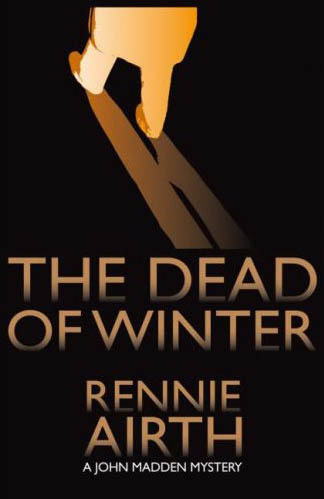
Review: DEAD OF WINTER - Rennie Airth


Title: The Dead of Winter
Author: Rennie Airth
Publisher: Pan Macmillan
Published: 2008
ISBN: 978 0 230 73696 2
RRP $32.99 (Aus)
THE DEAD OF WINTER is the third in the the John Madden series. The first novel, River of Darkness took place in England just after World War I.
DEAD OF WINTER is set in London in 1944 when a young Polish woman is garroted on the streets of a darkened city street. She is on her way to visit her aunt. Police begin investigating. John Madden, recently retired from the police force becomes involved because the young woman was living and working on his farm.
The young woman was universally liked and no one can figure out a motive for her death. She wasn’t robbed, she wasn’t sexually assaulted. The case becomes more complex when a prostitute who saw the girl tells the police she thought a man was following her. The prostitute is later found murdered in the same manner.
It ‘s not often that I don’t finish a review book. I feel obligated to read the entire book in order to do justice to the review.
Sadly, I had to give up on THE DEAD OF WINTER. Not because it was a necessarily a poorly written book. I don’t think it is. I have read worse and finished them. So why did I give up at page 197 of a 408 page book? I ran headlong into one of my pet peeves. This particular peeve is when the author pauses the plot to give the back story of a character. It’s all very fine and dandy for a couple of major characters but when the reader is being told the history of minor characters it becomes a major distraction. That’s what happened in this case. Do we really need to know the history of the relationship between the main character and the local village bobby, who up until i stopped reading the book had a very minor role. If this had been a movie it would have been with half a dozen lines.
When that was all I was noticing I decided to call it quits. This may be unfair to the author, but everyone has their quirks and Rennie Airth ran into one of mine.
For a less biased perspective perhaps read Michael Ripley's review on Eurocrime (http://www.eurocrime.co.uk/reviews/TDoW.jpg) or Nick Hay’s review on Reviewing the Evidence http://www.reviewingtheevidence.com/review.html?id=8155